10. Could RCS Itself Be Compromised?
Yes.
In the examined RCS database source, a user with the least operator role can reach code execution in the backend process. Any authenticated operator can also grant themselves every application privilege. Beyond those direct compromise paths, inconsistent ownership checks expose evidence and agent controls across investigations, while shared component credentials and weak service-to-service trust turn one compromised component into a possible route through the rest of the platform.
That answer needs boundaries. It is a source-backed assessment of the frozen RCS database snapshot reconstructed for this book, not evidence that somebody exploited a historical customer. The review was intentionally defensive and static-first: no implant or exploit code was built or run, no weaponized payload was used, and no external RCS infrastructure was contacted. The current lab also suppresses several original deployment paths by keeping MongoDB and the worker internal and relying on an isolated host. The console and published backend ports are loopback-only, but still require host-level isolation. These controls reduce reachability; they do not repair the underlying code.
The assessment validated 27 findings: three critical, seventeen high, and seven medium severity. Coverage was broad but partial across a 405-file snapshot, so the result is a demonstrated lower bound, not a declaration that every security-relevant path has been exhausted.
How the assessment was performed
I began with the platform model from Chapter 2 rather than a search for suspicious function names. Entry points were grouped by who could reach them: an unauthenticated network client, an ordinary operator, a delegated administrator, a component identity, or a client already inside the deployment network. The assets and required security decisions were then traced through REST controllers, WebSocket handling, Worker ingress, MongoDB models, task dispatch, backup and archive code, connectors, and filesystem helpers.
I required each candidate finding to connect an attacker-controlled source to
a meaningful sink or missing security decision. For authorization issues, that meant tracing
the role check, object lookup, item type, ancestry, and user_ids membership—not
merely observing that an endpoint existed. For parser and command findings, the
review followed data transformations into deserialization, evaluation, shell,
archive, or path operations. For component findings, it followed credentials
and authority across the trust boundary rather than treating every internal
connection as hostile by definition.
I kept validation proportional to risk. Source was sufficient where the control flow and consequence were complete, especially when a benign runtime experiment would enter a prohibited build path or add no confidence. The lab supplied deployment facts and safe behavioral context, but no command injection, arbitrary evaluation, destructive cross-investigation action, or pre-authentication resource-exhaustion campaign was executed. A finding is not weaker merely because the book withholds an exploit string; it is weaker when a prerequisite, sink, or consequence remains unproven, and those limitations are stated individually.
Severity combines achievable impact with the least authority and network position required in the examined design:
| Rating | Calibration used here | Example |
|---|---|---|
| Critical | A low-authority operator can obtain backend-process execution or complete application administration | Unsafe task evaluation; self-assignment of all privileges; view-accessible restore-to-shell path |
| High | A boundary failure exposes or changes victim data, crosses investigations, grants broad component authority, or creates a serious deployment-dependent takeover path | Foreign evidence access; shared server credential; unauthenticated bootstrap; MongoDB without authorization |
| Medium | Material availability, revocation, command, export, or integrity weakness with stronger privileges, optional features, or narrower impact | Stale sessions; Worker exhaustion; backup-name shell injection; connector path escape |
The immutable assessment identifier binds the chapter to
codex-security-snapshot/v1:sha256:63da7d1a5c75bc3be86076e68891284c4bbc6b8125b4369b327bed289911139e.
It does not imply exhaustive coverage or describe a customer installation.
Line citations in this chapter point to the examined source, while the claim
ledger records the prerequisite and limitation for every finding.
What had to be protected
RCS separated two kinds of authority that are easy to confuse.
The first was an operator’s functional role. Privileges determined whether a
user could administer people, manage operations, configure agents, inspect
evidence, run backups, or change system settings. The second was membership in
an investigation. Operations, targets, agents, and related objects carried
denormalized user_ids and paths intended to limit which customer data a user
could see.
A secure implementation needed both decisions on every request: may this role perform this kind of action, and may this user perform it on this particular object? Checking only the first question lets a legitimate analyst cross into another investigation. Checking only the second lets an analyst do something reserved for an administrator. Several RCS controllers do one and not the other; some sensitive task paths do neither precisely enough.
Other boundaries mattered just as much:
- unauthenticated clients versus the HTTPS, WebSocket, and worker parsers;
- components versus the generic
serveridentity they received; - the backend versus MongoDB, archives, frontends, and translation services;
- request data versus Ruby evaluation, command shells, archives, and local paths; and
- an authenticated session versus later changes to the user’s account.
The assets behind those boundaries included operator credentials, target identities, collected communications and location history, agent encryption keys, TLS and component secrets, backups, audit records, and the backend host itself. Compromise of RCS was therefore not merely compromise of an administrative application. It could expose a concentrated record of people already placed under surveillance.
The threat actors are not interchangeable:
| Actor | Starting position | Security-relevant reach demonstrated in source | What remains deployment-dependent |
|---|---|---|---|
| Unauthenticated external client | Can reach an RCS listener but has no account | Pre-authentication Marshal parsing, fixed bootstrap credential, position-resource path | Which listeners and features were Internet-reachable |
| Least-privileged operator | Valid VIEW-class session | Self-privilege replacement, unsafe task dispatch, local-file traversal, cross-investigation reads and some mutations | How an account or identifier was obtained |
| Delegated administrator | Narrow administrative privilege such as user or backup management | Cross-group access propagation or backup command construction | Customer delegation model and supported host path |
| Compromised component | Controls a collector, frontend, archive, Worker peer, or its credential | Generic server authority, signature/topology access, evidence and queue workflows | Component placement, credential reuse, and filtering |
| Deployment-network attacker | Can reach internal services or observe internal links | Worker resource allocation, plaintext frontend credential, unauthenticated MongoDB in bundled mode, archive interception | Actual segmentation, host firewalls, and transport replacement |
This separation prevents two opposite errors. Calling every issue “remote” would hide meaningful prerequisites. Calling internal services safe merely because manuals place them behind a firewall would ignore the compromised-node and malicious-operator cases the platform should have contained.
The six principal security properties fare differently:
| Security property | Assessment | Evidence behind the assessment |
|---|---|---|
| Operator identity cannot be impersonated or self-expanded | Fails | Editable privs, fixed bootstrap administrator, stale sessions |
| Investigation membership constrains every object action | Fails systematically | Unscoped evidence, GridFS, entity, agent, group, creation, and move paths |
| Untrusted input cannot reach ambient execution capabilities | Fails | Ruby evaluation, shell-assembled restore/backup commands, traversal in file/archive/export paths |
| Component compromise is contained to that component | Fails | Shared server secret and generic server authority; reverse archive credential exposure |
| Evidence confidentiality and integrity survive internal compromise | Not established | Broad component/database authority, plaintext optional links, unauthenticated MongoDB mode, incomplete audit assurance |
| Security-relevant actions remain attributable and recoverable | Partial | Audit and backup features exist, but sessions are stale, audit is not tamper-evident, and deletion/export paths are incomplete |
“Fails” applies to the validated paths in this snapshot, not every operation of the product. “Not established” is intentionally different: the review found controls insufficient to make the property dependable, but it does not claim that every stored record was altered or disclosed.
The findings at a glance
The table groups related findings so the security model remains visible. A “conditional” qualification means the vulnerable source path depends on an original deployment mode or feature not active in the isolated Linux lab.
| Area | Representative result | Attacker | Severity | Important condition |
|---|---|---|---|---|
| Task dispatch | Caller-controlled task type reaches Ruby evaluation | View-only operator | Critical | Authenticated API access |
| User administration | Operator can replace their own privilege set | Any operator | Critical | New privileges take effect on a fresh login |
| Backup restore | View-accessible restore input reaches a command shell | View-only operator | Critical | Original supported OS path; dormant in the Linux lab |
| Dangerous parsing | Ruby Marshal is loaded before authentication | Network client | High | Object construction and denial of service proven; an RCE gadget was not |
| Local files | Temporary-file identifier can traverse outside its directory | Any operator | High | Backend service account’s filesystem access |
| Evidence and GridFS | Foreign evidence can be read, changed, or deleted by ID | Low-privilege operator | High | Knowledge or discovery of object identifiers |
| Agent controls | Foreign queues, configuration, commands, and purge actions lack consistent ownership checks | Operator | High | Route-specific functional privilege varies |
| Group membership | User administrator can attach foreign items and propagate access | Delegated administrator | High | Has user-admin, not operation-admin, authority |
| Component trust | One shared credential grants broad generic server authority | Compromised component | High | Credential or component compromise |
| First boot | An admin-less system recreates a fixed full administrator | Network client | High | Default not overridden and listener reachable |
| MongoDB | Bundled all-in-one mode disables database authorization | Internal network client | High | Conditional deployment mode; lab does not publish MongoDB |
| Archive trust | Bootstrap, TLS verification, and credential disclosure permit interception or pivoting | First client, peer, or on-path attacker | High | Archive mode enabled |
| Session lifecycle | Demotion or disabling does not revoke an active session’s authority | Offboarded operator | Medium | Existing session remains alive |
| Worker availability | Unauthenticated ingestion allocates storage and processing state | Internal network client | Medium | Worker listener reachable; lab keeps it internal |
All 27 findings were confirmed by direct source traces. “High confidence” in this context means the defective control and its consequence are established in the examined code. It does not erase prerequisites, prove historical exposure, or turn a deployment-dependent path into a universal one.
Complete finding inventory
The grouped table above describes the security model; this inventory ensures that narrower findings do not disappear inside those clusters. IDs correspond to the claim ledger, where evidence paths and limitations are maintained.
| ID | Finding | Rating | Principal impact or condition |
|---|---|---|---|
| SEC-001 | Unknown task types reach caller-influenced Ruby evaluation | Critical | Backend-process execution from a VIEW session |
| SEC-002 | A user can replace their own privilege array | Critical | Full application administration after re-login |
| SEC-003 | Restore input reaches a shell-interpreted database command | Critical | Backend-process execution on the original supported helper path |
| SEC-004 | Restore, archive, move, and filesystem task classes lack task-controller privilege cases | High | Powerful task invocation from VIEW; effect varies by class |
| SEC-005 | REST and Worker parsers load Ruby Marshal before authentication | High | Object construction and denial of service; no RCE gadget claimed |
| SEC-006 | Admin-less bootstrap creates a fixed full administrator | High | First/default login takeover when the commissioned listener is reachable before credential replacement |
| SEC-007 | Generic temporary-file lookup permits path traversal | High | Read access to files available to the backend account |
| SEC-008 | Evidence and analytics reads omit consistent membership scope | High | Cross-investigation disclosure with identifiers |
| SEC-009 | Evidence update, translation, and deletion omit ownership enforcement | High | Foreign evidence and linked GridFS alteration or destruction |
| SEC-010 | Generic GridFS retrieval bypasses owning-resource policy | High | Direct binary or protected core disclosure with raw IDs |
| SEC-011 | Agent subresource routes inconsistently check ownership | High | Cross-operation configuration, queue, task, or purge access |
| SEC-012 | A user administrator can attach foreign items to groups | High | Access propagation without operation-administration authority |
| SEC-013 | Agent update/destroy accepts generic Item identifiers | High | A technician can close or delete an operation or target |
| SEC-014 | Moves and creates accept unscoped parents while ACL state is denormalized | High | Foreign insertion and stale or inherited access across investigations |
| SEC-015 | Active sessions retain old privilege snapshots | Medium | Disabled or demoted operators remain authorized until session loss |
| SEC-016 | Worker ingress allocates storage and processing before validation | Medium | Internal thread, memory, disk, and queue exhaustion |
| SEC-017 | Components share one credential and generic server authority | High | One component compromise expands across backend functions |
| SEC-018 | Bundled all-in-one MongoDB disables authorization | High | Direct database access from a reachable deployment network |
| SEC-019 | Fresh archive setup trusts the first unauthenticated client | High | Attacker-selected archive trust material |
| SEC-020 | Archive replication disables TLS peer verification by default | High | On-path interception of credentials and evidence |
| SEC-021 | Archive setup receives a credential valid back on the source | High | Compromised archive can pivot in the reverse direction |
| SEC-022 | Frontend synchronization sends the shared component credential over HTTP | High | Credential recovery by an internal observer or malicious frontend |
| SEC-023 | Backup name enters an unquoted shell command | Medium | Command execution with backup-admin authority on supported host path |
| SEC-024 | Unauthenticated position requests consume workers, cache, and third-party quota | Medium | Conditional resource exhaustion |
| SEC-025 | Translation sends evidence-derived text over HTTP and trusts returned text | Medium | Confidentiality and derived-evidence integrity exposure |
| SEC-026 | Local connector export paths use user-influenced display names | Medium | Conditional export outside the intended root |
| SEC-027 | Core ZIP extraction lacks destination containment | Medium | Conditional write outside build workspace; path not executed here |
Three patterns dominate this list. First, ambient execution capabilities—Ruby evaluation, a command shell, filesystem access, and archive extraction—sit too close to request data. Second, authorization is duplicated across controllers instead of owned by a single policy boundary. Third, infrastructure distribution uses shared authority, so a larger topology can enlarge the blast radius rather than contain it.
Four representative compromise paths
The findings become easier to reason about when assembled into paths. These are source-derived attack graphs, not records of exploitation and not step-by-step instructions.
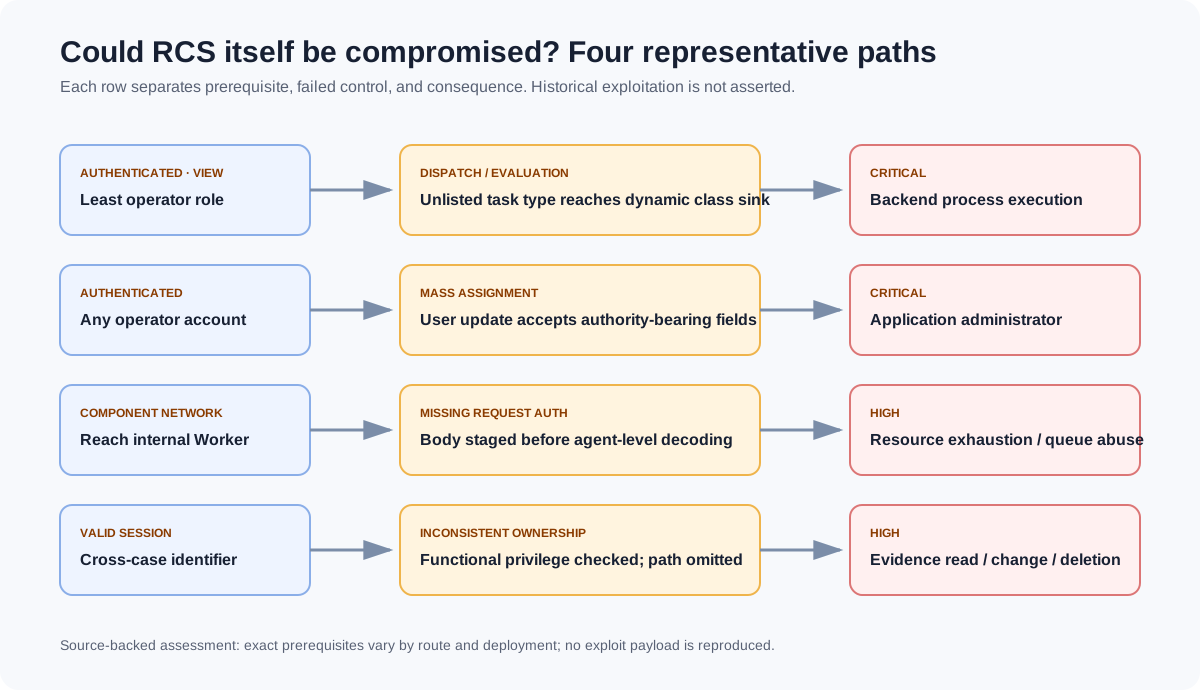
PATH A — ordinary operator to platform control

valid low-privilege session
        ├──> update own privilege fields ──> fresh admin session
        └──> unlisted task type ───────────> backend process authority
                                                   │
                                                   ▼
                                     MongoDB · keys · files · topology
Path A is decisive because network placement does not remove it. Once a valid operator session reaches the REST service, either branch crosses the intended least-privilege boundary. The first gives application authority using an ordinary model update; the second crosses into process authority through the task factory. They are independent failures and require independent fixes.
PATH B — analyst to another investigation

valid operator session + foreign object identifier
        │
        ├──> unscoped evidence/entity/agent lookup
        │          ├──> read metadata or binary
        │          ├──> change relevance/note/translation/configuration
        │          └──> delete/purge/queue action
        │
        └──> generic GridFS route ──> owning policy bypass
Path B does not need host compromise to harm confidentiality or integrity. It shows why the investigation is a security boundary, not just a UI folder. Raw identifiers may be learned from other API responses, logs, backups, browser state, or prior membership; treating unpredictability as authorization would not repair the missing checks.
PATH C — component or internal network foothold

observe HTTP link / compromise component / win archive bootstrap
        │
        ▼
recover or receive shared component credential
        │
        ▼
authenticate as generic server identity
        │
        ├──> topology and signature material
        ├──> agent/evidence workflows
        └──> authority back toward source or peer systems
Path C explains the architectural concern better than any single credential finding. RCS physically separates collectors, frontends, archives, Workers, and the Master, but its authorization model can reunite them as one principal. Segmentation still helps, yet it must contain both network reach and credential authority to stop a component foothold becoming a platform foothold.
PATH D — direct data-plane bypass

deployment-network access
        ├──> MongoDB without authorization ──> all reachable collections
        └──> unauthenticated Worker ingress ─> storage/processing exhaustion
Path D is conditional on deployment exposure, unlike Path A. It nonetheless matters because the bundled all-in-one helper is affirmative evidence of an insecure database mode, not speculation that an administrator might disable a control. The defensive lab removes host reachability for both services, so these paths describe source and deployment artifacts rather than its current external surface.
The paths can also combine. File traversal can disclose configuration that strengthens a component pivot; privilege escalation can unlock backup or signature endpoints; database access can reveal object IDs needed for a later application-layer action. Severity is calibrated on each finding’s own shortest credible path, while incident response must consider the composed graph.
From view-only access to the backend process
The most direct compromise path begins in the task controller. RCS accepts a
task type, performs authorization for a list of recognized values, and then
constructs the task class with Ruby eval. The authorization logic does not
reject an unknown type. A least-privileged authenticated user can therefore
choose text that escapes the intended class-name expression and is evaluated
in the database process (lib/rcs-db/rest/task.rb:24-43 and
lib/rcs-db/tasks.rb:368-375).
This is not merely a theoretical “eval is dangerous” observation. The input is controlled by the request, the allowlist is incomplete as an enforcement mechanism, and the sink evaluates that input. Successful execution would run with the backend’s access to MongoDB, configuration, keys, collected evidence, and the host filesystem. No payload is needed in this book to establish the path, and publishing one would add risk without adding evidence.
The critical sink is this dynamic class construction:
# rcs-db/lib/rcs-db/tasks.rb:368-373
def create(user, type, file_name, params = {})
  @tasks[user[:name]] ||= Hash.new

  params[:user] = user
  task = eval("#{type.downcase.capitalize}Task").new(type, file_name, params)
end
The excerpt contains no payload. It is enough to show that request-controlled
type reaches Ruby evaluation rather than a closed task-class mapping.
The same task boundary contains a second authorization defect. Restore,
archive, move-agent, and filesystem task classes are loaded by the server but
are absent from the controller’s privilege cases. A view-only session can
invoke them even though adjacent routes require stronger roles
(rest/task.rb:24-41; tasks/restore.rb:14-18; tasks/archive.rb:10-84;
tasks/move.rb:10-53; tasks/filesystem.rb:13-61). Those actions can restore
a database, destroy or relocate items, or export filesystem evidence.
Restore turns that missing check into another host-compromise route. Its
archive identifier flows into a quoted but otherwise unvalidated
mongorestore command assembled as one string. The platform helper executes
the string through the shell and retries it with backticks on failure
(rcs-db/lib/rcs-db/tasks/restore.rb:14-18;
rcs-db/lib/rcs-db/backup.rb:345-364;
rcs-db/lib/rcs-db/backup.rb:159-168). The
current Linux compatibility lab fails earlier because this old helper supports
the original Windows and macOS arrangements, so the path was not executed.
The source chain is nevertheless complete for the original supported path:
low privilege, attacker-controlled command text, and shell interpretation.
Backup creation has a related but narrower command injection. A user already
holding the specialized system-backup role can place metacharacters in a
backup name that is interpolated into an unquoted mongodump command
(rcs-db/lib/rcs-db/rest/backup.rb:23-40;
rcs-db/lib/rcs-db/backup.rb:49-168). It is medium rather than critical
because the prerequisite role is already powerful and the same platform
condition applies.
The shortest route to administrator
An even simpler application-level takeover does not need task dispatch. The
user-update endpoint permits an authenticated operator to update their own
record. It assigns request fields directly to the model, including privs,
without reserving privilege changes for a user administrator
(rest/user.rb:77-99; db_objects/user.rb:38-43). After logging in again,
the authentication manager copies those newly granted privileges into the
session (rcs-db/lib/rcs-db/auth.rb:75-96).
The consequence is total application privilege escalation by any signed-in account. It also illustrates why a list of nominal roles is not evidence of effective least privilege. The model can describe fine-grained separation, but a mass-assignment path can collapse all of it.
The endpoint restricts a non-admin to their own record, then forwards the remaining request fields directly to Mongoid:
# rcs-db/lib/rcs-db/rest/user.rb:81-98
user = User.find(@params['_id'])
@params.delete('_id')

unless @session[:level].include? :admin
  return not_found("User not found") if user._id != @session.user[:_id]
end

result = user.update_attributes(@params)
Ownership of the record is checked; authority over sensitive fields such as
privs is not separated from ordinary self-service updates.
Active sessions have the inverse problem. Their user and privilege data are a
login-time snapshot. Disabling a user, changing their password, or demoting
their roles does not invalidate that snapshot, and WebSocket pongs can keep
the session active (rcs-db/lib/rcs-db/auth.rb:75-96;
rcs-db/lib/rcs-db/rest/user.rb:77-118;
rcs-db/lib/rcs-db/websocket.rb:86-89). An operator who is being offboarded can therefore retain
their old authority until the session expires or server state is cleared. The
lab’s familiar same-user-login kick is not a general revocation mechanism: it
depends on another login and has its own user-addressed push behavior.
Investigation boundaries that do not hold
The most consequential cluster after direct backend takeover concerns object
ownership. Evidence queries, direct reads, filesystem and command views, IP
history, and some entity analytics do not consistently constrain results by
the caller’s user_ids. With another target or entity identifier, a
low-privilege analyst can disclose communications, files, location data, and
derived intelligence belonging to a different investigation
(db_objects/evidence.rb:245-308; rest/evidence.rb:135-622;
rest/entity.rb:34-62).
Mutation routes repeat the error. Update, translation, destroy, and bulk
deletion verify a functional privilege but not object ownership. The result is
cross-investigation alteration or destruction of evidence, including linked
GridFS content (rest/evidence.rb:102-205;
db_objects/evidence.rb:442-463).
The generic GridFS controller forms a separate bypass. It accepts raw object
and bucket identifiers and grants access to view or technical roles without
reapplying the stricter authorization of the evidence and core download
routes. Known identifiers can expose evidence binaries; the core index can
also disclose identifiers that the dedicated core-download route would have
protected (rcs-db/lib/rcs-db/rest/grid.rb:8-13;
rcs-db/lib/rcs-db/grid.rb:15-43; rcs-db/lib/rcs-db/rest/core.rb:13-43).
Agent actions are similarly uneven. Routes for queued commands, configuration,
tasks, synchronization, evidence purging, and other subresources often find an
agent without checking its user_ids; some mutation branches accept the view
role (rest/agent.rb:452-838). An analyst can consequently inspect or alter
the state of an agent from another operation.
Two less obvious defects show how authorization can fail through object type and graph maintenance:
- Agent update and destroy methods query the generic
Itemcollection. A technical user can supply the identifier of an operation or target and reach close or deletion behavior that the dedicated controllers reserve for administrators (rest/agent.rb:43-101;db_objects/item.rb:541-699). - A user administrator can enumerate operations and attach an arbitrary item
to a group without operation-administration authority or ownership. Group
callbacks then propagate the newly granted access down the object graph
(
rest/operation.rb:10-20;rest/group.rb:107-115;db_objects/group.rb:65-77).
Creation and move operations also accept destination parents without
consistently verifying that the caller owns them. Because authorization is
denormalized into descendants, moving an object can leave its path and
user_ids inconsistent: access from the source can survive in the
destination, or foreign state can be inserted into an investigation
(rest/target.rb:31-115; rest/agent.rb:111-126;
rest/entity.rb:87-95; db_objects/item.rb:185-203).
These are not isolated missing conditions. Together they show that RCS lacks a single authorization reference monitor. Each controller decides for itself how to combine privilege, type, ancestry, and membership. The security of an investigation is therefore only as strong as the least careful route that can reach one of its objects.
Danger before authentication
Some risk exists before a client becomes an operator. Both the REST parser and
worker accept a Ruby Marshal content type and call Marshal.load before the
request has been authenticated (rcs-db/lib/rcs-db/parser.rb:82-105;
rcs-db/lib/rcs-db/events.rb:145-157;
rcs-worker/events.rb:90-97). Marshal is a native Ruby object serialization
format, not a safe data interchange format for an untrusted boundary.
The parser performs object reconstruction while it is still preparing the request:
# rcs-db/lib/rcs-db/parser.rb:98-105
if request[:content_type]['multipart/form-data']
  request[:content] = parse_multipart_content(content, http[:content_type])
elsif request[:content_type]['ruby/marshal']
  object = Marshal.load(content) rescue nil
  request[:content] = object
  request[:content][:type] = 'object'
  params.merge!(object.stringify_keys) if object.kind_of?(Hash)
end
Authentication occurs later in request dispatch. The ordering and dangerous primitive are present. A compatible code-execution gadget remains unproven.
The source proves that a reachable unauthenticated client can make the process reconstruct attacker-selected object graphs and consume resources. It does not, by itself, prove a usable code-execution gadget in this exact frozen gem set. The finding is therefore high severity for dangerous pre-authentication deserialization and denial of service, with code execution explicitly left unproven.
First boot supplies another unauthenticated opportunity. If configuration
does not provide an administrator password and the database contains no admin,
startup creates a full-privilege admin account with a fixed documented
password (db_layer.rb:254-280). The original listeners bind broadly. A new,
reset, or accidentally exposed instance could be taken over by the first
client that knows the default. The lab deliberately confines access and uses
the known credential for reproduction, but that deployment control should not
be confused with a secure bootstrap design.
After authentication, a generic file endpoint makes local compromise easier.
Its caller-supplied _id is joined to the configured temporary directory
without containment, and parsed body or query data can override the path value
derived from the URI. Any operator can traverse to files readable by the
backend service, including configuration, TLS material, and database secrets
(rcs-db/lib/rcs-db/rest/file.rb:8-14;
rcs-db/lib/rcs-db/config.rb:105-112;
rcs-db/lib/rcs-db/rest.rb:200-206). In combination
with other flaws, this becomes a credential and pivoting primitive even when
it is not the first point of entry.
An unauthenticated position lookup is less severe but still structurally
important. It can drive fixed outbound resolution requests through a shared
worker pool and populate an unbounded cache. With the feature, licence, and
collector prerequisites in place, a remote client can consume threads,
memory, and third-party API quota (rest/position.rb:6-12;
position/resolver.rb:21-199). It is resource abuse rather than arbitrary
server-side request forgery because the destination is fixed by the service.
Components trusted as one large principal
RCS components authenticate with signatures, but the resulting separation is
weaker than the architecture diagram suggests. Components share a global
server secret and receive a generic server identity without a narrow
component-specific scope (rcs-db/lib/rcs-db/auth.rb:19-46;
rcs-db/lib/rcs-db/rest/signature.rb:12-33). Taking
one service or recovering its credential can expose topology, signatures,
agent queues, keys, status, and workflows beyond that component’s intended
role.
The frontend path sends that backend-wide credential in an HTTP header over
port 80 (frontend.rb:14-127). Anyone able to observe the internal path, or a
malicious endpoint standing in for the frontend, can recover a credential
accepted for broad server access. The optional translation subsystem likewise
sends evidence-derived text over hardcoded HTTP and trusts the returned text
for storage and search (rcs-translate/sdl.rb:18-40;
rcs-translate/processor.rb:45-88). These paths expose both control-plane
credentials and victim data to the internal network.
Archive replication compounds the shared-identity problem in three ways.
First, an archive node in fresh setup mode begins without signatures and
exposes /sync/setup before authentication; the first caller can choose its
trust material (db_layer.rb:291-301; rest/sync.rb:9-146). Second, archive
TLS verification defaults to VERIFY_NONE, so an on-path peer can impersonate
the archive while credentials and evidence are synchronized
(archive_node.rb:61-147). Third, setup sends all signatures to the archive,
including a source-server credential that the archive can use to authenticate
back to the source as the broad generic component identity
(rcs-db/lib/rcs-db/archive_node.rb:28-30;
rcs-db/lib/rcs-db/auth.rb:19-45). A workflow intended to move
evidence one way can therefore create authority in the opposite direction.
The worker has its own unauthenticated availability boundary. Its ingress
stores arbitrary request bodies and allocates per-UID processing state before
agent association and decryption have succeeded. There are no effective body,
queue, identity-cardinality, or disk limits on that path
(rcs-worker/events.rb:43-154; worker_controller.rb:8-25;
instance_worker_mng.rb:14-59). A client that can reach the worker network can
consume threads, memory, GridFS storage, and processing capacity. The compose
lab keeps this port internal, which materially reduces present reachability.
The bundled all-in-one MongoDB startup is another deployment-dependent high
risk. It explicitly disables Mongo authorization, supplies no cluster
keyfile, and enables Mongo’s old HTTP interface; the application configuration
contains no database username or password (bin/rcs-db-mongo-all:35-62;
config/mongoid.yaml:1-14). Any client that reaches those database listeners
can bypass all RCS sessions and investigation controls. The reconstructed lab
does not publish MongoDB to the host, so this is a finding about the shipped
deployment helper rather than an exposed lab service.
Finally, optional export paths cross the filesystem boundary with display
names that lower-privilege users can influence. A local connector constructs
directories from operation, target, and agent names without containing the
result beneath its export root (rcs-connector/extractor.rb:26-31,79-89). If
the connector is enabled, crafted names can redirect sensitive exports.
What platform compromise could change
“RCS was compromised” is too coarse for incident reporting. The impact depends on which authority was obtained and which stores were reachable.
| Asset or authority | Possible consequence in the validated model | Evidence a responder should seek |
|---|---|---|
| Operator account | Foreign-investigation access, self-promotion, task creation, evidence changes | Session and push state, account/privilege history, REST logs, audit events, workstation artifacts |
| Backend process | Read or modify configuration, keys, databases, files, tasks, and component state | Process tree, memory, open files/sockets, application traces, filesystem timeline, persistence |
| MongoDB router or shard | Bypass application policy and alter items, evidence, GridFS, accounts, audit, or queues | Database logs, oplog where available, collection/index inventory, BSON-preserving comparison, backups |
| Worker | Denial of processing, staged-blob manipulation, decoder artifacts, possible access to agent processing context | grid.evidence, Worker logs, failure directory, process/network state, queue timing |
| Component credential | Authenticate with generic server authority and move across component workflows | Signature records, component logs, authentication traces, topology changes, credential copies |
| Evidence or GridFS object | Disclose, annotate, translate, replace, orphan, or delete victim material | Metadata/binary hashes, reference/chunk joins, counters, audit, alerts, exports, historical archives |
| Agent configuration and queues | Change future collection behavior or create misleading operator intent/state | Config versions, queued requests, sync history, agent status, task and push records |
| Backup/archive authority | Recover deleted data, replace current state, disclose historical evidence, or change trust material | Archive directories and hashes, job definitions, restore logs, signatures before/after, database deltas |
| Audit authority | Delete, insert, or omit records inside the same trust domain | External host/network logs, immutable copies, backup comparison, gaps in identifiers and clocks |
Control of the backend process or database has the widest consequence, but a narrower evidence-level compromise can still be severe for the person represented by that record. Conversely, an availability attack against the Worker may interrupt new processing without proving that stored evidence was read. Reports should state confidentiality, integrity, availability, authorization, and attribution effects separately.
Compromise also weakens the evidentiary meaning of the platform’s own output. An attacker able to alter evidence documents, GridFS bytes, agent paths, annotations, derived entities, or audit records can create inconsistencies or plausible-looking state. This does not mean every record from a compromised RCS server is false. It means authenticity must be rebuilt from independent device, network, database, backup, operator, and cryptographic evidence rather than assumed from the Console label “Evidence.”
A conditional build-path finding
The server extracts entries from a stored core ZIP beneath a build workspace
without first proving that each normalized destination remains inside that
workspace (rcs-db/lib/rcs-db/rest/core.rb:60-74;
rcs-db/lib/rcs-db/build.rb:74-85). If a system or technical user who can
replace a core archive also has build authority, and a later build consumes
that archive, traversal can write files with the backend service account’s
authority.
This is a medium, conditional finding, not an invitation to test the implant toolchain. The defensive lab contains no operational core or build assets, prohibits build tasks in its web console, and does not execute this code. Static review is sufficient to identify the missing containment check.
What the assessment did not prove
Several tempting conclusions would exceed the evidence.
The review does not show that a historical HackingTeam customer exposed these listeners to the public Internet, that an operator account was stolen, or that any named person exploited RCS. Network placement, product version, customer configuration, and later vendor patches could change reachability.
The pre-authentication Marshal path is not labelled remote code execution without a validated gadget. A malformed WebSocket message and a pre-auth heartbeat path can raise deterministic exceptions, but the review did not establish whole-reactor impact. The old dependency set has not yet received a version-appropriate advisory audit, so present-day vulnerability databases must not be projected backward without publication dates and affected-version evidence.
A cross-repository review also found that evidence import can select a global
fallback cryptographic key when a header flag is set. That may permit forged
evidence when combined with knowledge of a valid agent identity, but the root
decoder lives in rcs-common, outside this assessment’s canonical target. It
remains a strong follow-up hypothesis until a dedicated cross-component trace
has checked all prerequisites and consequences.
Partial coverage matters. The assessment concentrated on externally reachable parsers, authorization, privileged workflows, component trust, storage, and secrets. It did not claim exhaustive manual review of every file in the snapshot. The 27 validated findings are enough to answer the chapter’s main question, but not enough to answer every possible question about the product.
How the platform should have been defended
The 27 findings do not call for 27 unrelated design projects. They cluster into three structural opportunities: put authorization behind one owned policy boundary, remove ambient execution and filesystem authority from request handlers, and replace the generic component principal with scoped identities. Local patches are still necessary, but without those ownership changes the same mistakes can recur in a neighboring controller.
The current design can be reduced to this security-relevant view:
operators ──> REST controllers ──> model lookups ──> MongoDB / GridFS
                   │       │
                   │       ├── local privilege and membership decisions
                   │       └── eval / shell / archive / filesystem helpers
                   │
components ── shared server credential ───────────> broad backend routes

Control ownership: dispersed among controllers and helpers
Audit position:     beside business actions, inside the same trust domain
The observed facts are the unscoped lookups, dangerous sinks, shared credential, stale session snapshot, and incomplete audit paths. The structural diagnosis is an inference: security policy and privileged capabilities have no single owner, so correctness depends on every caller remembering every rule. The proposed design below is not evidence that RCS was fixed; it is a way to make those invariants enforceable.
Desired invariants
We would want the replacement boundary to make these statements testable:
- Every request is authorized against the current account, the final typed resource, its ancestry, and its current investigation membership.
- Unknown actions and task types fail closed before class lookup or allocation.
- Request-controlled values never enter Ruby evaluation or a command shell.
- Every filesystem or archive destination is normalized and proven to remain under an owned root before a read or write.
- GridFS access is derived from an authorized owning evidence/core record, not from a caller-selected bucket.
- Each component identity has separate, rotatable credentials and only the routes required for its role.
- Evidence-changing and privilege-changing actions produce durable audit records outside the authority of the application process performing them.
Three hardening options
Option 1: strengthen every existing route. Patch the known controllers and helpers in place: add missing membership checks, constrain model types, close the task allowlist, remove Marshal, use argument-vector process execution, and contain paths. This option preserves the protocol and process layout and is the fastest way to interrupt the demonstrated paths. Its weakness is recurrence: policy remains duplicated, so a new route or forgotten pseudo-view can recreate the same class of defect. It is attractive as emergency containment and remains necessary during any longer migration.
Option 2: centralize policy and broker dangerous capabilities. Introduce a typed authorization layer that resolves the resource and evaluates action, role, ancestry, and membership once. Controllers receive an authorized handle, not a raw identifier. Task creation uses a closed registry. Separate archive, filesystem, process, and GridFS brokers own normalization and enforce narrow operations. This preserves one backend deployment while changing control ownership. I recommend this as the balanced structural target for the examined architecture: it directly addresses the repeated causes without requiring an immediate rewrite into many services.
Option 3: add service and investigation isolation. Place task/build, backup/restore, Worker ingestion, connectors, and storage behind separate process or service identities, and consider database credentials or physical stores scoped by customer or investigation. This provides the strongest blast- radius reduction: a parser or connector compromise need not inherit the Master’s whole authority. It also carries the highest compatibility, availability, and operating cost. It becomes preferable where multiple customers or mutually distrustful operator groups share a platform, or where the value of collected evidence justifies tenant-grade isolation.
Under Option 2, the security-relevant architecture would look like this:
operators ──> authentication/session ──> policy decision
                                             │
                         typed authorized resource handle
                                             │
                 ┌───────────────┬───────────┴───────────┐
                 ▼               ▼                       ▼
             data API       task registry         capability brokers
                 │               │             file/archive/process/GridFS
                 └───────────────┴───────────┬───────────┘
                                             ▼
                                    scoped MongoDB access

components ── distinct verified identity ──> role-specific routes
all security transitions ──────────────────> external append-only audit sink
The important delta is not another middleware check. Raw identifiers and strings no longer carry ambient authority into privileged helpers. The policy layer owns resource identity; brokers own dangerous side effects; component credentials express one role rather than “server.” A compromised REST handler would still be serious, but it would have fewer direct capabilities to inherit.
| Dimension | Option 1: local guards | Option 2: policy and brokers | Option 3: service/tenant isolation |
|---|---|---|---|
| Security | Closes known paths; drift remains | Removes repeated causes and narrows ambient capabilities | Strongest containment, including process and credential boundaries |
| Performance | Likely near-neutral; checks stay in process | Adds policy resolution and broker calls; cache behavior must be measured | Adds serialization, network/process hops, and possibly duplicated storage work |
| Memory | Near-neutral beyond policy metadata | Small policy caches/registries likely; unmeasured | Multiple runtimes, queues, and buffers increase baseline use |
| Reliability | Minimal topology change; inconsistent failures can remain | Central policy/broker outage becomes a backend dependency but can fail closed | Better fault isolation but more partial-failure and retry states |
| Operability | Familiar deployment, larger regression matrix | New policy telemetry, broker health, and credential lifecycle | Highest deployment, monitoring, key, backup, and incident-response burden |
| Migration | Lowest; compatible tactical patches | Incremental route migration is possible behind existing API | Highest; protocols, data ownership, rollout, and rollback need redesign |
These directions are source-derived or architectural hypotheses, not measured benchmarks. A design review would need representative authorization throughput, large-evidence download, task, backup, Worker burst, and failure-recovery tests. Option 2 should be accepted only if policy and broker overhead stays within the existing operator latency budget and fail-closed behavior does not turn one policy error into an unrecoverable platform outage. Option 3 needs explicit queue, retry, data-consistency, and disaster-recovery objectives before it can be judged proportionate.
The immediate fixes follow from the direct compromise paths: replace dynamic task evaluation with a closed mapping; reject every unknown task; reserve privilege fields for a separately authorized administrator action; pass commands as argument arrays without a shell; remove Marshal from all remote formats; and contain every joined or extracted path beneath an approved root.
Those patches alone would leave the deeper authorization problem. A durable
design needs one policy layer that evaluates action, object type, ancestry,
and current investigation membership for every controller. Queries should be
scoped before lookup, not checked inconsistently after a generic object has
been returned. Membership should have one authoritative representation or a
transactional rebuild, rather than callbacks that leave paths and user_ids
out of sync. GridFS blobs need authorization derived from their owning record,
not caller-supplied bucket and object identifiers.
Sessions should reference current account state or be revoked on password, role, and enabled-state changes. Bootstrap should require a one-time secret delivered out of band and force rotation. MongoDB should require authentication and cluster credentials even on an all-in-one installation.
Components need separate identities, distinct secrets, and route-specific capabilities. Frontend, archive, worker, translation, and connector traffic should use authenticated encryption with peer verification. Archive setup must not be first-client-wins, and a receiving archive should never receive a credential that grants broad authority back on the source. Worker ingress needs authentication, bounded request bodies, per-source quotas, backpressure, and storage limits before allocation.
Most importantly, telemetry should treat the surveillance backend as a high-value security domain. Privilege changes, cross-operation access, task creation, restores, evidence mutation, component authentication, and bulk downloads require complete, tamper-resistant audit records and alerts. RCS was built to collect evidence from compromised machines. Its own design needed to assume that operators, components, internal networks, and archives could also become hostile.
Migration and validation priorities
The sequence should follow exploitability and preserve tactical protection during redesign:
- Remove dynamic evaluation and remote Marshal parsing; close task dispatch; contain every path; revoke the fixed bootstrap path; and authenticate or isolate MongoDB and Worker ingress.
- Make privilege changes separately authorized and revoke sessions on account, password, or role changes. Add shared negative tests for foreign operations, targets, agents, entities, evidence, and GridFS objects.
- Introduce typed policy handles route by route. Keep local ownership checks until each route has moved and the old lookup cannot be reached.
- Rotate the shared component secret into distinct identities, then restrict each route before removing the old credential. Upgrade optional plaintext and non-verifying links with authenticated peer verification.
- Move security audit outside the application trust domain and exercise recovery from privilege abuse, evidence mutation, queue failure, database loss, and archive compromise.
Acceptance is behavioral, not diagrammatic. The original source-to-sink paths must be re-traced against the changed code; every supported role must pass both same-investigation and foreign-investigation tests; unknown tasks must fail without class resolution; invalid archive and filesystem paths must fail before I/O; component credentials must be rejected outside their routes; account changes must terminate existing REST and WebSocket authority; and audit records must survive compromise of the application account. Until those checks pass, the proposals mitigate nothing in the historical code described here.
The answer in context
Could RCS itself be compromised? In this snapshot, yes—decisively. With any authenticated operator account, self-promotion and unsafe task dispatch offer short paths to control. Without an account, dangerous deserialization, defaults, bootstrap modes, and reachable internal services create additional opportunities whose practical severity depends on deployment. If a component falls, shared credentials and broad server authority weaken containment.
The current reconstruction is safer because it runs on an isolated host, keeps MongoDB and the worker inside the compose network, binds the console to loopback, binds the host-published backend ports to loopback, excludes operational implants and exploits, and disables real build behavior. Those ports must still be protected by host isolation. These are external guardrails around historical code, not claims that the code has become secure.
That distinction is the useful lesson. A surveillance platform can have elaborate licensing, encryption, roles, certificates, and topology while still fail at a few ordinary boundaries: untrusted input entering an interpreter, editable authorization fields, unscoped object lookup, shared credentials, and unauthenticated bootstrap. The sophistication of what a system does to its targets tells us very little about how well it protects its own operators—or the people whose lives accumulate in its database.
Sources and evidence
- SOURCE: static review of
docker-lab/rcs-db, snapshot digestcodex-security-snapshot/v1:sha256:63da7d1a5c75bc3be86076e68891284c4bbc6b8125b4369b327bed289911139e. - SOURCE: the 27 validated findings and coverage record in the private research assessment; severity mix critical 3, high 17, medium 7.
- LAB:
docker-lab/docker-compose.yml,docker-lab/README.md, and the web console’s compliance tests establish the reconstruction’s network and no-build boundaries. - LIMITATION: no implant or exploit execution, no weaponized backend validation, no external infrastructure, partial source coverage, and no completed dependency-advisory audit.
↑ HackingTeam's RCS: Bringing a Commercial Spyware Platform Back to Life