Inside a Network Appliance: Assessing NetScaler ADC 14.1
Network appliances are often treated as sealed boxes. In reality, most modern appliances, especially virtual appliances, are software distributions built from a general-purpose operating system, open-source middleware, third-party libraries, scripts, and proprietary services.
That composition is not inherently unsafe. Apache, PHP, OpenSSH, OpenSSL, Python, PostgreSQL, and FreeBSD can all be operated securely. The risk appears when a vendor combines a large software inventory with weak privilege separation, inconsistent authorization, incomplete exploit mitigations, opaque updates, and limited forensic visibility.
This post examines one such system: a NetScaler ADC VPX appliance running NetScaler 14.1 build 73.30. It is not a claim that every NetScaler version or deployment behaves identically. It is a case study of one exact build, tested inside an isolated and disposable lab.
Why network appliances deserve endpoint-level scrutiny
Firewalls, VPN gateways, load balancers, routers, and application delivery controllers sit on important trust boundaries. They terminate authentication, hold keys and credentials, parse hostile network traffic, and can often change how traffic reaches the rest of an organisation.
They are also awkward to monitor. Installing a normal endpoint detection and response agent is commonly unsupported or impractical. Defenders instead depend on whatever logs, telemetry, integrity data, and export mechanisms the vendor chose to expose. If those mechanisms are incomplete, an attacker may have more visibility into the device than its operator.
This is not merely a theoretical concern. Joint guidance from the UK NCSC, CISA, NSA, and partner agencies says that compromises of network devices and appliances are increasing, and identifies insecure design, weak authentication, delayed updates, and limited logging as recurring risk factors. The same guidance calls for centralised monitoring and better forensic capabilities in edge devices:
- NCSC: digital forensics and protective monitoring for network appliances
- NSA: mitigation strategies for edge devices
The practical lesson is simple: an appliance should be assessed as both a network service and a privileged endpoint. A version scan and a configuration check are necessary, but they do not answer how its internal trust boundaries behave after one component is compromised.
The appliance in this case study
The assessed artifact was NetScaler ADC VPX 14.1 build 73.30, dated 27 July 2026. It ran on a vendor-modified FreeBSD 11.4 system. The lab appliance was a management-only baseline: it had an NSIP but no VIP, SNIP, backend service, Gateway, AAA, GSLB, load-balancing, or application virtual server.
The virtual machine had one adapter connected to a VirtualBox host-only network. It had no bridged or NAT interface and could not reach the public Internet. The original appliance and installation artifacts were preserved. Testing was performed against a repaired full clone with a clean snapshot that was restored after each stateful test.
This configuration matters. It exposed the management plane for testing, but many optional packet-processing paths were dormant. A dormant vulnerable component is still present in the image; it is simply not reachable under the current configuration.
What was actually inside
The appliance had two broad runtime planes:
- The packet plane. The proprietary
nsppeprocess owned traffic processing and several externally visible services, including management TLS front ends. - The management plane. FreeBSD services provided SSH, the administrative web application, configuration RPC, authentication, telemetry, monitoring, synchronisation, and support functions.
Observed components included:
| Layer | Observed technology | Role |
|---|---|---|
| Operating system | FreeBSD 11.4-NETSCALER-14.1, amd64 | Vendor kernel and userland |
| Packet engine | nsppe |
Proprietary traffic, protocol, and management front end |
| Configuration | nsconfigd, nscli, nsnetsvc |
Administrative command and configuration plane |
| Web server | Apache HTTP Server 2.4.67, prefork | Administrative UI and API front end |
| Web application | PHP 8.1.34 and CodeIgniter 3.1.13 | GUI and NITRO/RAPI handlers |
| Remote administration | OpenSSH 9.7p1 | SSH access to the appliance CLI |
| Cryptography | OpenSSL 3.0.19 | OpenSSH and native component dependency |
| Automation | Python 3.14.3 | Upgrade, telemetry, ADM, and monitoring helpers |
| Other scripting | Perl 5.30.2, Bash 3.2.57, POSIX shell | Web integration, maintenance, and boot logic |
| Supervision | Monit 5.0.3 and proprietary pitboss |
Process monitoring and startup |
| Persistent data | SQLite 3.48.0 files | Small appliance databases |
| Bundled database | PostgreSQL 15.17 | Installed, but inactive in the inspected baseline |
PostgreSQL binaries and libpq were present, but no PostgreSQL process,
listener, default data directory, or persistent PG_VERSION was observed. A
MySQL client library also existed without evidence of a running MySQL server or
a PHP database module. This distinction is important: installed is not the
same as active, and active is not the same as externally reachable.
Detect It Easy could not identify the compiler or language of nsppe,
nsconfigd, or nscli. Their ELF metadata contains a FreeBSD Clang 10.0.0
string, although linked startup or library objects could have contributed it.
IDA Pro found stronger C++ indicators in nsppe: GCC/Clang-style mangled
names, classes, constructors, destructors, virtual calls, and raw uSTL type
strings. This supports the presence of C++ object code, but IDA’s automatic
names can be wrong and its C-like pseudocode does not prove C source. No
comparable C++ cluster appeared in nsconfigd or nscli. Their exact source
language, and that of individual vulnerable functions, therefore remains
unproven.
Hardening: some useful controls, some large gaps
The assessment did not reduce hardening to a single score. There were positive controls:
- 103 of the 107 executable ELF files under
/netscalerdeclared a non-executable stack; none declared an executable stack. - No reviewed product executable had a writable-executable load segment.
- Null-page mapping was disabled and stack guard pages were enabled.
- The saved appliance configuration was root-owned and mode
0600. - SSH disabled empty passwords, X11 forwarding, gateway ports, and TCP forwarding.
The broader picture was considerably weaker:
- The
/netscalercensus contained 107 executable ELF files: 71 64-bit and 36 32-bit. - 106 of 107 were fixed-address
ET_EXECimages rather than PIE. - Only one had a
GNU_RELROsegment, and none requested immediate binding. - 78 carried
RPATHorRUNPATH, often exposing build-time library paths. - In a narrower set of 37 core runtime images, only six exposed stack-canary and fortified-libc symbols.
- Most packet and control-plane services ran as root.
nsconfigdhad no visible privilege drop, jail, chroot, or Capsicum setup.- Kernel securelevel was
-1; PID randomisation was disabled; normal and set-ID core dumps were enabled. /var/tmpwas mode0777without the sticky bit.- SSH permitted the root account and password authentication. The normal login
flow starts
nscli; a sufficiently privileged administrator can then request the appliance’s root shell by design.
These facts do not prove exploitation. They describe the blast radius and the amount of resistance available after a memory-safety, injection, or trust boundary flaw is found. Missing PIE or RELRO is not the initial vulnerability, but it can make a successful exploit more reliable. Running a parser as root does not create malformed input, but it makes parser failure much more consequential.
The threat model
The assessment protected five primary asset classes:
- administrator sessions, passwords, tokens, and private keys;
- the saved and running appliance configuration;
- the integrity and confidentiality of traffic handled by the packet plane;
- availability of management and packet-processing services; and
- durable state under
/flashand/var.
The visual model separates attacker-controlled paths from normal application and control flow. Dashed lines mark the transitions where identity and authority should be re-established rather than inherited.
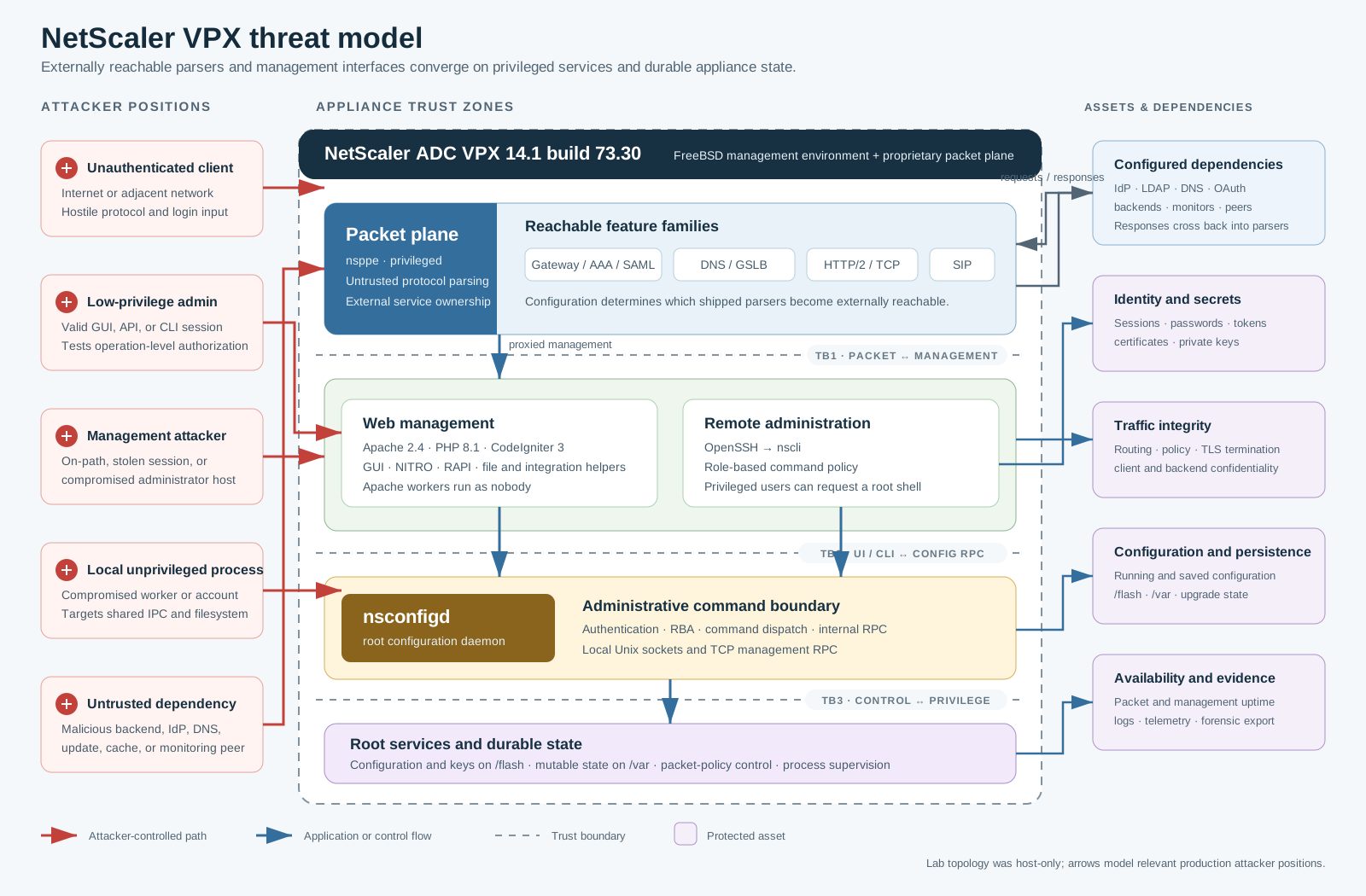
The lab itself remained host-only. The external actors in this model represent the positions relevant to a deployed appliance, not systems contacted during testing.
The attacker positions were deliberately different:
| Attacker position | Question |
|---|---|
| Unauthenticated network client | Can hostile protocol input bypass authentication, corrupt memory, or exhaust a privileged service? |
| Authenticated low-privilege administrator | Are GUI, API, CLI, file, and integration permissions enforced consistently? |
| Management-network attacker | Are credentials and sessions protected against interception and unsafe outbound integrations? |
| Unprivileged local process | Do local IPC endpoints verify operating-system identity, or merely trust their location? |
| Malicious or compromised backend | Can DNS, LDAP, SAML, OAuth, cache, or monitoring responses attack privileged parsers? |
| Update or supply-chain attacker | Are images, libraries, signatures, and rollback paths independently verifiable? |
How the appliance was assessed
The work combined complementary methods rather than treating one scanner as a complete answer.
1. Preserve and identify the exact artifacts
The original ZIP, TGZ, OVF, VMDK, and extracted binaries were retained.
Conclusions that depended on a binary were tied to its build and SHA-256. For
example, the assessed nsppe had SHA-256
6ce73d12c24d2c23e77fbc8234091dd069b610b658455a7dc18b087ee8890f85,
and nsconfigd had SHA-256
46b0563fc221d2b9c14286d5ed6e36e8d8a5c76278b6727f2fa3993e88a70ec1.
2. Inventory the running system
Runtime checks recorded processes, identities, sockets, packet-engine listeners, routes, enabled features, databases, filesystems, SSH policy, Apache modules, interpreters, and persistent state. Running and saved configuration were compared when vulnerability applicability depended on a feature being enabled.
3. Inspect binaries and extracted application code
file, readelf, strings, dependency metadata, source searches, and IDA Pro
decompilation were used to trace potentially dangerous behavior. IDA-generated
names and pseudocode were treated as approximations, not recovered source.
Potential findings had to include a plausible source, control failure, sink,
attacker position, and reachable configuration.
4. Test trust boundaries with differential controls
Dynamic tests used generated markers and disposable low-privilege accounts. Every meaningful positive result was paired with a negative control. For example, wrong credentials versus altered login flags, a built-in read-only policy versus a narrowly scoped custom policy, or a real route versus direct network access using the same identity.
Independent observations were preferred over application success messages. Packet capture, controlled HTTP or LDAP receivers, filesystem hashes, audit logs, and configuration hashes established whether a claimed side effect actually occurred.
5. Keep the lab disposable
No public system was tested. No production data, keys, cookies, or credentials were retained. Tests avoided real configuration and private files. Temporary accounts, policies, listeners, and markers were deleted, after which the clone was powered off and restored to its clean baseline snapshot.
Results
A critical local configuration-RPC trust failure was confirmed
The strongest runtime result was in nsconfigd, the root configuration daemon.
It created predictable Unix-domain sockets under /tmp with other-write
permission. Connections accepted through those listeners were marked as local
and trusted without a visible peer-UID check. The login RPC also accepted
client-controlled flags that requested authentication and role-based
authorization bypass.
The runtime test dropped to UID and GID 65534. Invalid dummy credentials were
rejected normally. Changing only the login flags to 0x0201 caused the login to
succeed. On the same connection, the unprivileged client executed the protected
read-only show version command twice. The appliance audit log recorded both
the invalid identity login and the command as successful.
This demonstrates unauthorized administrative command execution across a root-owned service boundary. It does not demonstrate an interactive root shell, arbitrary native code execution, or a configuration-changing command; those stronger effects were not attempted. Before and after the command, the saved configuration retained the same size, timestamp, and SHA-256, and the daemon remained running as root.
Low-privilege management authorization mostly worked, until helper routes bypassed its intent
A representative GUI, NITRO, and SSH/CLI matrix produced consistent decisions.
The built-in read-only user could view the version, certificate metadata, and
system statistics. It could not create an inert load-balancing object or list
files under /tmp. No write canary remained afterward.
Several web helper routes exposed different authority:
- AUI-10: a built-in
read-onlyGUI user triggered a blind outbound connection to a caller-selected private host and port. A VirtualBox NIC trace observed the SYN packets; the route’s own success response was not accepted as proof. - AUI-13: the same built-in role selected an arbitrary LDAP host and port, caused a bind and search, and received a synthetic returned attribute through RAPI.
- AUI-09: the built-in read-only role was denied, but a user with only the four import commands checked by the handler fetched a private URL and received its marker body. Receiver logs and loopback packet capture confirmed the request.
The administrative UI review retained 16 reportable source-supported candidates: three High and thirteen Medium. The three High candidates involved a recoverable administrator password in MFA transition state, active session and third-party credentials written to the PHP error log, and HA enrollment transmitting credentials with TLS peer verification disabled. The Medium group covered URL-borne credentials, session handoff, uploads, outbound HTTP and LDAP integrations, cross-partition report ownership, and resource limits. Most are static or configuration-dependent findings, not claims of locally reproduced exploitation.
Negative controls removed several attractive but incorrect findings
An assessment is only useful if it can disprove its own hypotheses.
- AUI-03
copyfile: arbitrary source and destination paths were real, but the copy succeeded only after the account was authorised forsftp-server. That same identity could directly read the marker through SFTP. No additional file authority was demonstrated, so the proposed High privilege escalation was suppressed. - AUI-04 help traversal: literal and encoded dot segments were rejected by the stock front end before PHP. The candidate was suppressed for this configuration.
- AUI-12 XenServer destination control: PHP 8.1 terminated the legacy
XML-RPC serializer at its removed
each()call before a socket was opened. Packet checks saw no selected-destination traffic, so the candidate was suppressed for this build. - AUI-20 forced logout: the error page looked like a logout, but revisiting the root page restored the authenticated dashboard. The session had not been invalidated.
These are not wasted tests. They prevent plausible-looking code paths from becoming exaggerated vulnerability claims.
Static review found additional packet-engine risk, with configuration caveats
The nsppe review retained nine source-supported issues: three High-severity
memory-corruption candidates and six Medium-severity memory-safety,
availability, or credential-exposure findings. The strongest paths involved
DNS packed-name handling, DNS TXT formatting, and a SAML Redirect decompression
variant. The Medium group covered DNS and CAA logical over-reads, HTTP/2
small-window resource retention, an out-of-bounds SAML NUL write, malformed
distributed-cache record handling, and OAuth refresh credentials appearing in
diagnostics.
No malformed packet, crash, disclosure, or code execution was produced. The lab had no DNS/GSLB or Gateway/AAA service configured, so the relevant entry points were not dynamically exercised. The static findings apply to the exact 73.30 binary; first-affected and fixed versions are unknown without vendor source history or comparison builds.
Where the recent vendor CVEs cluster
The assessment considered two recent Citrix bulletins: CTX696604 and CTX696939. Together, they contain eight NetScaler CVEs. They are not a statistical history of every NetScaler flaw, but their prerequisites show a useful concentration:
| Area | CVEs in the reviewed bulletins | Vendor-described surface |
|---|---|---|
| Gateway, AAA, and SAML | CVE-2026-8451, CVE-2026-8452, CVE-2026-19490 | SAML IdP or SAML-enabled Gateway/AAA processing |
| Packet and traffic features | CVE-2026-8655, CVE-2026-10817, CVE-2026-13474, CVE-2026-19489 | Oracle/DNS processing, TCP timestamps, HTTP/2, and SIP ALG on LSN |
| Management-address file surface | CVE-2026-10816 | Unauthenticated access through an NSIP, Cluster IP, or management-enabled SNIP |
Seven of these eight CVEs therefore depend on an optional authentication, protocol, or traffic-profile feature. The remaining issue is exposed through a management address. This points primarily toward the appliance’s proprietary edge-processing and management logic, rather than ordinary upstream defects in Apache, PHP, or OpenSSL.
That last attribution needs care. Citrix’s bulletins identify preconditions and
impact, but do not name the responsible executable for every CVE. Local reverse
engineering places CVE-2026-8452 and CVE-2026-19490 in nsppe and corroborates
the related HTTP/2 small-window behavior. It does not prove that every CVE in
the table resides in the same binary.
The operational takeaway is to inventory enabled features, not merely open ports. SAML actions, Gateway and AAA virtual servers, DNS modes, HTTP and TCP profiles, LSN groups, and management-enabled addresses materially change which shipped parser paths are reachable.
CVE status depended on both version and configuration
Two public CVE assessments illustrate why a version match is not a complete exposure decision:
- CVE-2026-8452: build 73.30 is newer than Citrix’s fixed 14.1 build floor and contained evidence of the relevant SAML size checks. The assessed build was considered fixed. The dormant Gateway/AAA configuration independently reduced exposure but was not the basis for calling it patched. This was a static assessment: no malformed SAML request or exploit was sent. See the Citrix bulletin.
- CVE-2026-19490: build 73.30 was in Citrix’s affected version range, and
static evidence attributed the likely path to
nsppeSAML Redirect handling at/cgi/samlauth. However, both running and saved configuration had zero SAML actions, zero AAA virtual servers, and zero VPN virtual servers. The installed software was version-affected, but the current configuration did not expose the required feature combination. No authentication-bypass request was sent. Upgrade to 14.1-73.32 or later remained necessary before enabling the affected features. See CTX696939.
What this example says about appliance engineering
The central problem was not that the appliance used open source. The problems were architectural:
- Too much code shared a privileged trust domain. A local socket mistake became critical because the receiving daemon ran as root and could dispatch administrative commands.
- Authorization was not consistently expressed at the operation boundary. The main management APIs enforced role decisions, while helper and integration routes exposed outbound or protocol-specific capabilities.
- Exploit resistance was inconsistent. Non-executable stacks and the absence of RWX mappings were positive, but PIE, RELRO, immediate binding, canaries, and fortified calls were sparse.
- Optional features still enlarged the shipped attack surface. Inactive PostgreSQL, legacy XML-RPC code, multiple scripting runtimes, and dormant protocol handlers still require inventory, updates, and ownership.
- Operational visibility cannot be an afterthought. If ordinary EDR is unavailable, the appliance must provide trustworthy remote logs, process and configuration integrity, software inventory, supportable forensic export, and alerts when telemetry is disabled.
A secure appliance should make the safe path the easy path: minimal services, dedicated identities, private authenticated IPC, memory-safe or strongly hardened parsers, operation-level authorization, narrow outbound policies, verified updates, and useful evidence for incident responders.
What a safer implementation could look like
The most valuable architectural change would be to stop treating root as the normal execution identity for the packet and control planes. Root should be a narrow capability held by a small, auditable broker, not an ambient property of every parser, protocol handler, monitoring agent, and configuration service. The same principle applies even where a component legitimately needs privileged operations: the privileged code can own the NIC, hardware queue, key store, or configuration commit while an unprivileged worker parses attacker-controlled input and requests a small set of typed operations.
For this appliance, a plausible target split would be:
| Boundary | Proposed design | Security consequence |
|---|---|---|
| Packet plane | A minimal privileged I/O broker passes bounded messages to dedicated, unprivileged Rust protocol workers | A DNS, SAML, HTTP/2, or decompression bug does not automatically inherit all of nsppe’s authority |
| Configuration plane | An unprivileged RPC front end authenticates the caller; a small root-owned apply service accepts only typed, authorised operations | Socket access and client-supplied flags cannot stand in for identity, and command execution is removed from the parsing boundary |
| Administrative UI | Replace PHP controllers and shell-oriented helpers with an unprivileged Rust service behind a central authorisation API and explicit outbound-request broker | Removes the PHP application/runtime from this boundary and makes file, network, and configuration capabilities easier to constrain |
| Persistence and secrets | Separate services expose narrow handles for configuration state, certificates, and credentials | Web or parser compromise does not grant direct filesystem-wide read/write access |
This is privilege separation, whether or not containers are involved. On the assessed FreeBSD base, jails can isolate processes, filesystems, users, and networks, while Capsicum can restrict a process to explicitly delegated file descriptors and operations. Those native mechanisms are a more direct starting point than adding Docker to this particular image.
Docker could still be useful in a future Linux-based appliance, but it is not a
synonym for least privilege. The conventional Docker daemon runs as root;
rootless mode instead runs
the daemon and containers in a user namespace. A useful deployment would also
drop all unneeded capabilities, retain the default
seccomp policy, use a
read-only root filesystem, isolate temporary storage, bound CPU and memory, and
avoid mounting the host filesystem or control socket. A privileged container
with host networking, raw devices, broad capabilities, and writable host mounts
would mainly repackage the current trust domain. This is especially relevant to
nsppe: a high-speed packet engine may need raw packet and device access, so
process decomposition matters more than the container label.
Rust is a strong fit for the attacker-facing parsers identified here. Moving
DNS name handling, SAML Redirect decompression, HTTP/2 state, cache-record
decoding, and similar code into safe Rust would make use-after-free,
out-of-bounds access, and many lifetime errors substantially harder to express.
It would not eliminate memory-safety review: Rust deliberately permits
unsafe code for FFI,
devices, and low-level operations. Such code should be small, isolated, audited,
and fuzzed at the boundary.
Rewriting the administrative UI in Rust could retire PHP, CodeIgniter, and several shell-heavy integration paths, but the most important UI findings were logic failures: inconsistent authorisation, SSRF-like outbound capabilities, unsafe path handling, secret logging, and disabled TLS identity checks. Rust does not correct those automatically. The replacement would need central operation-level authorisation, typed paths and destinations, default-deny egress, secret-redacting types, bounded request bodies, verified TLS, and no general-purpose shell interface.
Nor can the available binaries prove that all proprietary native code was C or C++; ELF metadata does not identify the source language reliably. “No C/C++ anywhere” is also an unrealistic appliance-wide assurance while the kernel, drivers, cryptographic libraries, and third-party dependencies remain native. A more meaningful and testable goal is: no attacker-controlled bytes are parsed by privileged memory-unsafe application code.
This should be an incremental migration, not a flag-day rewrite. First fix the existing IPC authentication failure, move sockets into private directories, drop service identities, disable privileged core dumps, and enable modern compiler/linker hardening. Then replace one parser or UI route at a time behind stable interfaces, using differential tests, captured protocol corpora, fuzzing, performance budgets, and rollback. Only after the new path has matched required behaviour under load should the legacy implementation be removed. Containers and Rust can materially reduce risk, but the decisive improvement is the authority boundary around them.
Make the appliance observable like an endpoint
An appliance that cannot support a conventional EDR agent needs more
purpose-built security telemetry, not less. This image already contained audit
logging, local syslog, SNMP, Monit, health, metrics, and telemetry components.
The appliance audit log was useful during this assessment: it independently
confirmed that the invalid identity and protected command in the nsconfigd
test were recorded as successful. That proves useful events exist; it does not
establish that logging is complete, tamper-resistant, or reliably exported.
Availability, recovery, rate limiting, log exhaustion, remote-delivery failure,
and alert latency were inventoried but not dynamically tested.
A redesigned appliance should therefore expose a documented security-telemetry contract with stable, machine-readable events for:
- authentication results, session creation and revocation, role decisions, policy changes, and transitions into the underlying root shell;
- every attempted and committed configuration operation, including the authenticated principal, originating interface, transaction identifier, affected object, result, and a secret-free change digest;
- enabled features and listeners, certificate and key lifecycle operations, software upgrades, rollbacks, boot-image selection, and integrity failures;
- process starts, crashes, watchdog restarts, privilege or sandbox changes, resource pressure, parser rejection, and rate-limit activation;
- outbound DNS, HTTP, LDAP, SAML, ADM, telemetry, and update connections, including the policy decision and TLS peer-verification result without logging credentials or tokens; and
- the health of monitoring itself: monotonic sequence numbers, clock state, dropped-event counters, queue pressure, collector acknowledgement, and any attempt to disable or reconfigure export.
Events should leave the appliance promptly over mutually authenticated, encrypted transport to an operator-controlled collector. Local buffering is still useful during an outage, but it should be bounded, integrity-protected, and generate a visible gap or loss counter after reconnection. High-value audit events should not be suppressible by the same web worker, parser, or low-privilege administrator whose actions they record. Stable schemas and event IDs would also let vendors ship maintained SIEM detections rather than forcing each operator to reverse-engineer prose logs.
Internal telemetry is only one evidence source because a fully compromised appliance may falsify it. Independent controls can observe the same boundary from outside: management-firewall and flow logs, switch or virtual-switch packet metadata, hypervisor lifecycle and virtual-device changes, remote configuration snapshots, and read-only API polling for build, feature, listener, certificate, and policy drift. Correlating those records with the appliance event stream makes missing or contradictory evidence detectable. This follows the principle in the joint NCSC guidance on protective monitoring for network appliances: monitor the edge device centrally and retain enough evidence for investigation.
Forensic support should be designed rather than improvised after compromise. A sanitised export should include a signed software inventory, boot and upgrade history, process and listener snapshots, configuration digests, event-loss counters, and bounded crash context. Passwords, session tokens, private keys, complete configurations, and unrestricted memory dumps should be excluded or separately encrypted with explicit operator approval. Better visibility is not an excuse to create a second repository of appliance secrets.
Conclusion
This is not a rant about NetScaler, nor a claim that every NetScaler release or every network appliance contains the same flaws. NetScaler is the concrete case study because its image was available for exact-build analysis. The broader subject is the way many appliances are implemented: a general-purpose operating system, open-source middleware and runtimes, and proprietary services combined into a product whose most exposed components often hold extensive privilege. The same assessment method and engineering questions apply to firewalls, VPN gateways, routers, storage systems, hypervisor managers, and other nominally closed boxes.
This NetScaler VPX image was not an opaque box. It was a substantial FreeBSD software system combining modern and legacy open-source components with highly privileged proprietary code.
The assessment confirmed one critical local trust-boundary failure and several authenticated outbound-management primitives. It also found substantial static risk in the web and packet planes and weak binary-hardening coverage. Just as importantly, runtime controls disproved several initially plausible findings, and the current configuration made one version-affected CVE inapplicable while another CVE was already fixed in the installed build.
Some defects can and should be patched individually. In my view, however, some appliance architectures cannot be made adequately secure through an endless sequence of point fixes. When attacker-facing parsers, management integrations, authorization decisions, shell helpers, secrets, and durable configuration all remain close to a broad root trust domain, the recurring risk is structural. Such systems need a strategic redesign and staged reimplementation using privilege-separated services, authenticated and typed IPC, memory-safe parsing, central authorization and egress controls, modern platform hardening, and externally verifiable telemetry. Existing vulnerabilities still require prompt patches, but tactical remediation should not be mistaken for correcting the architecture that keeps producing them.
That combination is the real lesson. Appliance security cannot be measured by a logo, a CVE count, or the presence of a familiar open-source package. It requires an inventory, a threat model, exact-build analysis, adversarial testing of trust boundaries, explicit negative controls, and enough telemetry to know when those boundaries fail.
#NetScaler #Network Appliances #Reverse Engineering #FreeBSD #Secure by Design